Collapsible Scooters: 11 Things You're Leaving Out
How a Collapsible Scooter Can Make Your Day Easier Collapsible scooters are great for traveling or for long walks. They're lightweight, easy to fold and air-tight so you can take the scooters on planes and buses. Some scooters fold by the lever, whereas others require you to put a screw in the handlebars. It is essential to select a collapsible bike that is right for you. Mobility Devices that are able to be transported Mobility devices that are transportable can help you get where you need to go, whether traveling by bus, car or train. You can choose a scooter that fits in the trunk of a car and folds up for storage when not in use or disassembles to fit in the overhead compartment on an airplane. These models are ideal for long-distance travel, in addition to local stores, museums or vacation destinations. They weigh only a few pounds, making them easy to carry and lift by one person. Verify with the airline prior booking your flight to see if your mobility device is accepted. Certain airlines permit you to carry a scooter in your carry-on luggage while others require that you check it in with them. The weight and size can be a major factor in how easily a mobility device can be moved. It can also affect the speed, maximum incline range and the maximum lifting height. This is why it is best to opt for the device that weighs as low as is feasible without sacrificing durability or security. The ground clearance of the mobility scooter is an additional aspect to be considered. A large clearance on the ground is essential if you plan to drive your scooter over rough terrain such as dirt, grass, or gravel. Some models come with minimum ground clearance of 1.5 inches, whereas other models have up to 5 inches. In addition to the ground clearance of a mobility scooter, you should also be aware of the maneuverability and turning radius. This is especially important when the mobility device will be used to maneuver through narrow spaces such as aisles in stores, hallways or other areas that are tight. The turning radius of mobility scooters range from 31 inches to 72 inches depending on the model. You may also have to make use of a measuring tape to determine how far the scooter can turn in these narrow spaces. 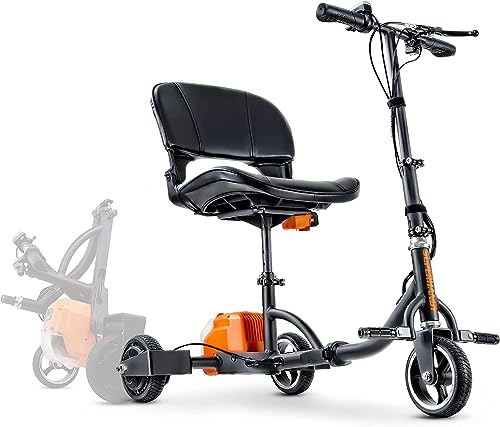 Mobility Devices that have a Clearance of Ground If you're rushing to get to your next appointment or a night out, a mobility aid with a high clearance will help you get from A to B. collapsible scooter mobility is essential for those who are crossing rough terrain such as grass, dirt, gravel or sand. The best mobility devices are those that are lightweight and easy to maneuver, as well as having very little turning radius. Some of the latest inventions include foldable scooters that can be folded into a suitcase style to fit inside your trunk easily. Certain models fold electronically at the touch of a button. This reduces effort, but still retaining their original weight. The most difficult part is deciding on the right device for your preferences and needs. You should speak with an expert in mobility for recommendations on the best device to suit your needs. This will ensure that you purchase the product that is in line with your highest expectations. You can also contact your local dealer for discounts and offers you will not find and everywhere else. lightweight collapsible scooters may be surprised at the number of trustworthy manufacturers and dealers in your area. Mobility Devices with a Short Turn Radius A mobility device that has a small turn radius allows the user to get in and out of tight spaces quickly and easily. This makes it easier to maneuver within kitchens, restrooms and other public areas. It doesn't matter if it's an electric wheelchair or a scooter, or a reclining wheelchair the turning radius is among the most important features to take into consideration when selecting a mobility device. It's crucial because it determines the amount of space needed to turn 180 degrees. For a power wheelchair, it is typically just 20 inches. For motorized scooters and motorized devices, this can be as large as 40 inches. This is vital because it could affect how easily you can navigate your mobility device through tight corners. It also helps you avoid hitting furniture and objects. A great mobility device will also have advanced brake systems. These include electromagnetic brakes and automatic brake systems. These types of systems are typically more efficient and safer than manual braking. Another important aspect of mobility devices is their ground clearance. If you are planning to drive your mobility device across rough terrains such as dirt, grass, sand, gravel, and thick carpets it is recommended to choose the one with a greater ground clearance. If you intend to use your device in public areas, a low ground clearance could lead to slipping and sliding. If you're a wheelchair user who frequently navigates through tight, narrow spaces, this feature is crucial. You should also verify whether the mobility device you choose features an anti-tipping function to stop it from tipping over. Mobility Devices that Have Advanced Braking Systems Mobility devices with advanced brake systems are an ideal option for those with limited mobility. These devices are more comfortable to use than standard scooters and provide an extra-secure ride. These systems can cut down on the number of accidents and save lives. Honda's City Brake Active System, for instance, uses cameras and radar technology to determine if there's the possibility of a collision with an object that is in the vicinity of the vehicle. It then warns the driver through a series of audio and visual alerts. If a driver doesn't respond to these alerts then the system will take over and apply the brakes to avoid an accident. These kinds of systems are an important security feature, and can help reduce or even eliminate one of three fatal crashes. The iBOT Mobility System has a Gyroscope that is able to automatically maintain the stability of the driver as they drive on uneven terrain. This gyroscope is also able to help the user climb steps and curbs, as it sends signals to a built-in computer that controls the motors under the wheels to maintain stability. In the future the near future, new brake system architectures are likely to be more modular and adaptable. As a result, previous centralized components can be relocated to various locations within the vehicle. This will allow the separation of the pedal and pressure generation, which is typically accomplished by a separate brake-bywire system. The braking system could be placed anywhere on the vehicle. This allows it to be coupled with other functions, including power seating. This will ultimately enable more people to safely and efficiently travel.